
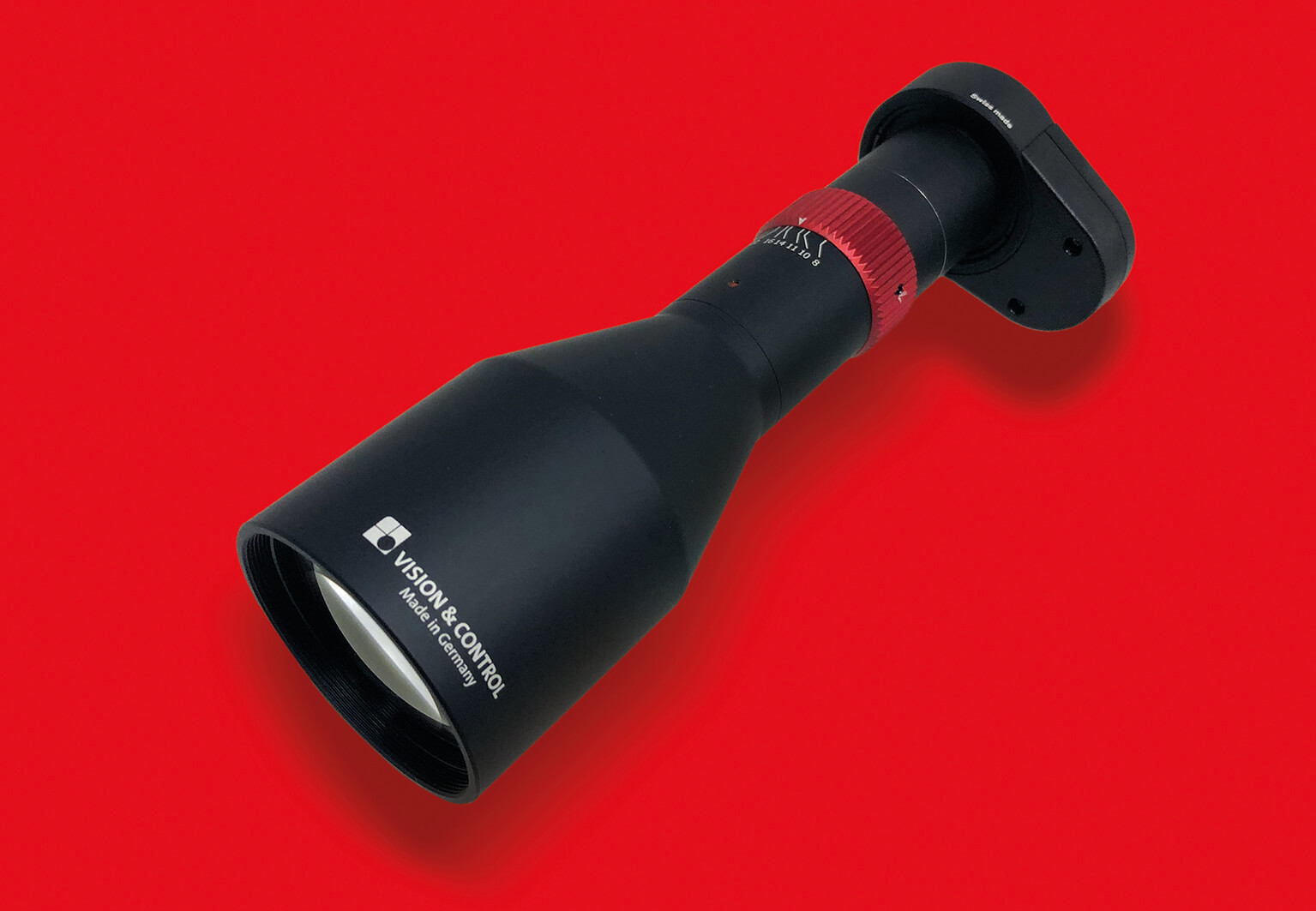
When object distances vary or inspections are performed on multiple levels, conventional optical systems with mechanical focus adjustment inevitably reach their limits, as they are too slow and prone to wear. Liquid lenses offer an interesting alternative here: They enable fast, precise focus adjustment without any mechanical movement at all. Vision & Control specifically employs this technology to provide robust and maintenance-free machine vision systems for highly dynamic processes.
In practice, this technological flexibility translates directly into tangible benefits, particularly in automated quality control and metrology. A typical scenario is the inspection of complex components. In this scenario, different depth planes can be focused in milliseconds without any mechanical adjustments.
The Versatile Application Scenarios
A look at a wide variety of industries reveals just how significant the added value of liquid lenses is. Especially in flexible production lines where components of varying heights or shapes are processed, time-consuming mechanical adjustments are completely eliminated. In electronics manufacturing, for example, dynamic focus shifting ensures consistently high image quality when inspecting solder joints or assembled circuit boards. This is true even when component heights vary significantly.
Similar advantages are evident in the automotive industry: Here, a single camera is now sufficient to produce sharp images of complex structures such as cylinder heads or transmission components. Liquid lenses also demonstrate their strengths when dealing with challenging surfaces. For example, in the packaging industry, they ensure reliable reading of codes on curved or uneven materials, and in the pharmaceutical industry, they enable precise, dynamic height adjustment when inspecting blister packs.
Seamless integration
Technologically, the liquid lenses from Optotune integrated here are based on a flexible membrane that changes its curvature when an electrical voltage is applied, thereby adjusting the focus. Since this happens within milliseconds, the response times are extremely short compared to conventional mechanical systems. To fully exploit this potential, the vicosys® image processing platform seamlessly integrates control of the liquid lenses and enables software-controlled focus shifting in real time.
Special system commands allow the focus point to be set automatically and read with precision. This not only ensures comprehensive documentation and process control but also simplifies the hardware architecture: Since separate control units are no longer needed, the solution can be implemented much more easily in existing production environments.
Custom-fit liquid lens solutions from a single source
To successfully implement such systems in practice, Vision & Control provides users with comprehensive support. This begins with engineering and extends all the way through to manufacturing. This is made possible by a broad range of telecentric, wide-field, and encentric measurement and microscope lenses. Combined with custom optical designs and precise hardware adaptations, even highly complex, customized requirements can be met with an extremely short time-to-market.
Photonics and AI are converging
The future of industrial image processing lies in the intelligent integration of photonics-based sensors and data-driven analysis. Artificial intelligence is increasingly enabling the automatic classification of defects as well as adaptive inspection strategies in real time. Combined with responsive systems such as liquid lenses, which adjust the focus range in milliseconds based on AI specifications, this gives rise to autonomous and highly flexible next-generation inspection solutions.
The combination of adaptive liquid lens technology and powerful image processing opens up entirely new possibilities for automation. The key advantage here is the elimination of moving mechanical components: This not only makes the optical systems extremely fast and precise in focusing but also significantly increases their service life and reliability. These delay-free focus changes demonstrate their full potential particularly in high-speed applications and dynamic in-line inspections, where every fraction of a second determines the system’s cycle time.
published in ElektronikPraxis 7/2026