
No two machine vision tasks are the same. Different products, inspection characteristics, camera systems and cycle times place constantly changing demands on hardware and software. At the same time, machine vision systems must be reliable, scalable and maintainable over the long term. In practice, projects rarely fail because of the inspection task itself. The real challenges lie in integration into existing machines and processes, system stability and the processing power required for reliable 24/7 operation. What is needed, therefore, are platforms that combine flexibility, stability and performance within a single architecture. Rather than developing individual stand-alone solutions, machine builders and system integrators need a technological foundation that can be adapted to different applications while supporting future extensions.
This is precisely where the vicosys® machine vision platform comes in. It has been developed to handle a wide range of machine vision tasks on a unified hardware and software basis. Users receive a machine vision system tailored to their specific application – from single-camera applications to complex multi-camera systems.
Machine vision on a unified platform
As a central unit, vicosys® handles all the key tasks of industrial machine vision: image acquisition, image processing, decision-making and communication with the higher-level machine control system. Unlike conventional vision systems, the platform is not restricted to specific camera models, interfaces or application areas.
Its open architecture enables the integration of a wide range of camera technologies and connection to industrial control and automation environments. This creates a flexible system foundation that can be adapted to individual requirements while reducing engineering effort.
For project-based applications: from concept to industrial solution – faster
Every machine vision application presents its own challenges. Inspection characteristics may change, additional cameras may be required or new quality criteria may need to be taken into account. The platform has therefore been designed to allow existing systems to be expanded without the need for fundamental redevelopment.
All the essential functions for industrial vision applications are already integrated:
Integration of up to 16 cameras
Support for relevant industrial interfaces
Real-time-capable Linux runtime environment
Integration of thermography and specialist cameras
This significantly reduces development and integration times. At the same time, users benefit from a platform that has proven itself in numerous industrial applications and is designed for reliable continuous operation.
Another key advantage is its technological openness. Custom image processing algorithms, existing software modules and modern AI applications can all be integrated with ease. The vcwin engineering software enables applications to be configured, visualised and adapted quickly. HALCON and deep learning frameworks can also be used to integrate modern AI methods for anomaly detection, classification and segmentation tasks.
An efficient platform for series machine builders, too
In addition to customer-specific projects, the platform is particularly well suited to standardised machine concepts and series production. Machine builders face the challenge of standardising machine vision solutions across different machines while retaining the flexibility to adapt them to individual requirements.
vicosys® combines image acquisition, image processing, PLC communication and visualisation in a single system. This reduces the number of components required while simplifying implementation, maintenance and servicing.
Key benefits include:
Support for a wide range of camera and sensor technologies
A unified hardware and software basis across different machine types
Scalability from one to 16 cameras
Direct communication via EtherCAT, PROFINET and digital I/O
Long-term availability of proven industrial platform technology
With vcwin, user interfaces and process sequences can be developed efficiently and subsequently transferred to other machines. This reduces development effort and shortens the time to market for new equipment.
Applications in industrial quality inspection
The platform demonstrates its strengths particularly in applications where conventional standard solutions reach their limits. These include demanding inspection tasks involving multiple cameras, high speeds or complex surface structures.
Seamless integration into existing production environments is equally important. Direct communication with PLCs, machine control systems and higher-level systems makes machine vision an integral part of the manufacturing process rather than an isolated stand-alone solution.
Scalable to meet application requirements
Different performance classes are available to suit individual applications.
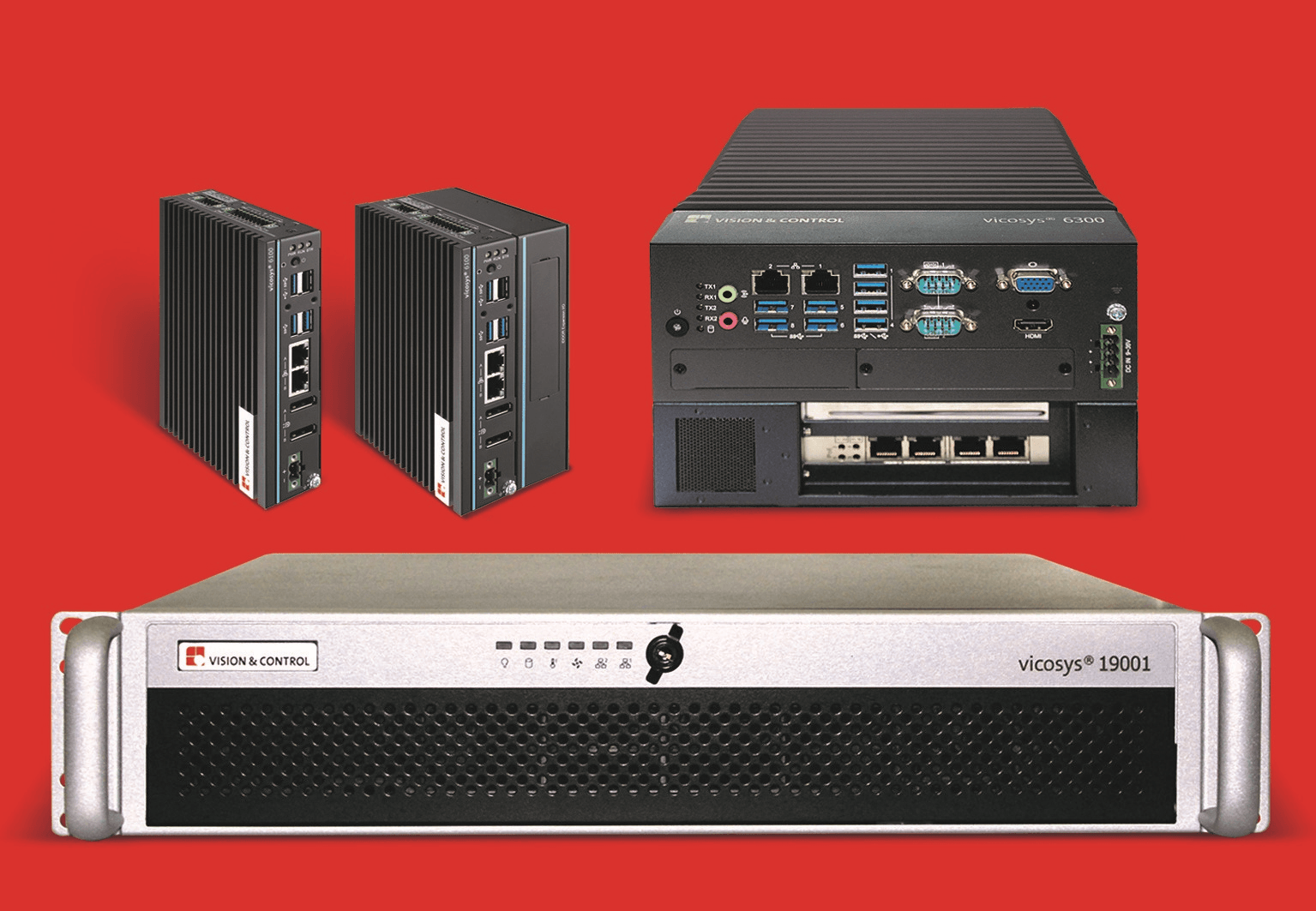
vicosys® 6100 is designed for compact applications using one or two GigE cameras. Its space-saving design allows installation on a DIN rail, making it suitable for conventional inspection and quality control tasks.
vicosys® 6300 offers additional processing power and extended interfaces for more complex applications. This platform is particularly well suited to AI-based image processing and demanding surface inspection tasks.
vicosys® 19001 has been developed for particularly data-intensive applications. Where compromises are not an option! Multi-camera systems, high-speed inspections and print image inspections requiring millisecond-level processing all benefit from its high processing power and extensive expansion options.
Conclusion
The demands placed on industrial machine vision continue to increase. At the same time, the need for flexible, scalable and maintainable solutions with long-term availability is growing. Universal platform approaches enable machine builders, manufacturers of series machinery and system integrators to implement a wide range of applications on a common technological basis.
The vicosys® machine vision platform provides a solution that combines conventional image processing, modern AI methods, industrial communication and visualisation within a unified architecture. This creates powerful, future-proof solutions for both individual projects and standardised machine platforms.